
Blog > Bass vs. Raman: What the 2026 LA Mayor’s Race Could Mean for HPOZs and Single-Family Neighborhoods in Los Angeles
Bass vs. Raman: What the 2026 LA Mayor’s Race Could Mean for HPOZs and Single-Family Neighborhoods in Los Angeles
by
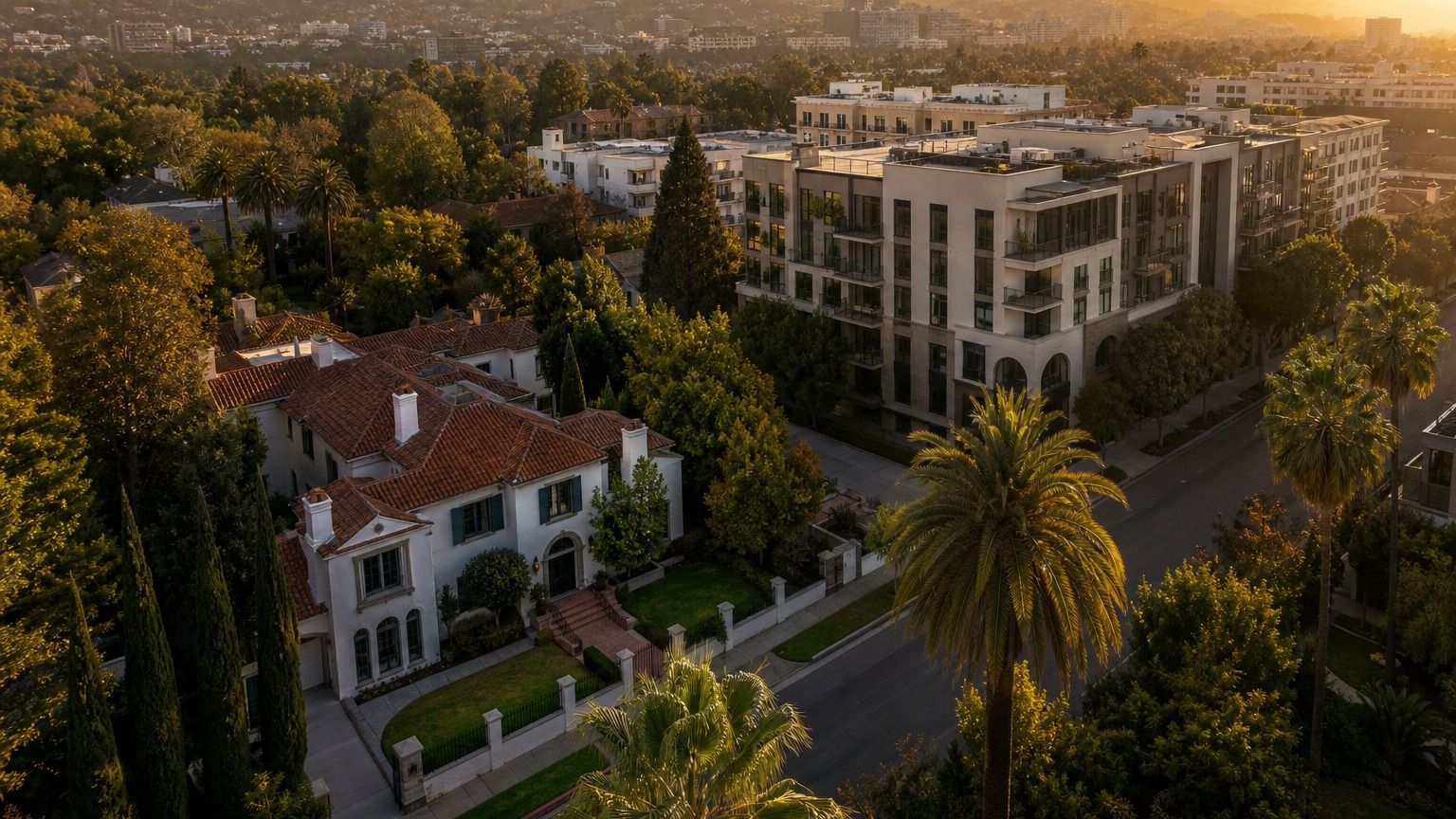
AI-generated conceptual illustration showing higher-density multifamily development beside a historic single-family home. It does not depict a specific property, proposed development or HPOZ.
As the November 3 election approaches, I wanted to put together some facts to help homeowners make an informed decision about the candidates for mayor of Los Angeles. I realize that many people don’t feel either candidate is a great choice. I hear that every day. But I would really encourage you to learn what you can about the issues that matter to you and vote, even if you can’t get 100% behind either choice. As my dad used to say, sometimes you have to vote against someone rather than for someone, or you risk the consequences of your voice not being heard at all.
I’m writing specifically about the additional housing density SB 79 is intended to allow, how it may affect our single-family neighborhoods and HPOZs, and the candidates’ positions on these issues, as expressed in their own words at a neighborhood forum I attended on September 24. The link to that forum is included at the end of this article.
Los Angeles needs more housing. Karen Bass and Nithya Raman agree on that.
Where they differ is where that housing should go, how much additional density should be allowed in lower-density and single-family areas, how quickly projects should be approved, and how much control Los Angeles should retain over those decisions.
For voters in Historic Preservation Overlay Zones such as Hancock Park, Windsor Square, Lafayette Square, Spaulding Square, Miracle Mile North, and many others, those differences matter.
And because SB 79 is now state law, this is no longer a theoretical argument about what a future mayor might do.
If you do not follow housing legislation closely, “SB 79” may not mean much. SB 79 is a new California law that requires Los Angeles to allow substantially more housing near certain rail and major transit stops, including on some properties historically zoned for single-family homes. Depending on the location, that can mean taller buildings, more units and less local discretion than homeowners may expect.
Quick Answers
Bass: Supports substantial housing production, but opposed SB 79 and argues Los Angeles should retain more local control over where added density goes.
Raman: Wants housing production increased more aggressively, including duplexes, triplexes and fourplexes in some single-family neighborhoods near transit, along with faster by-right approvals.
For HPOZs: Los Angeles’ current implementation temporarily protects many locally designated historic districts from SB 79, but those protections are not necessarily permanent after 2030.
SB 79 Changes the Starting Point
SB 79, explained above, took effect July 1, 2026.
Los Angeles responded with a Phased Implementation Ordinance and Low-Rise Ordinance. The City is using the phased approach to delay SB 79 on qualifying sites while it develops its longer-term strategy. The Low-Rise Ordinance expands smaller-scale multifamily housing near selected transit areas, but currently excludes this expansion in HPOZs.
For historic neighborhoods, that sounds reassuring. The problem is that the protection is temporary. Under a future local Alternative Plan, City Planning says exemptions for local historic areas are limited to 10% of a transit station area. Where HPOZs and Historic-Cultural Monuments exceed that threshold, the City may have to accommodate additional housing capacity elsewhere within the transit area and potentially on some locally designated historic parcels.
So HPOZ status is not an automatic permanent shield from SB 79.
That is one reason the next mayor’s approach to Sacramento, City Planning and local control matters.
Wondering whether your property may be affected by SB 79? Reach out and I can help you look at its location in relation to qualifying transit areas and point you to the appropriate resources for confirmation.
Bass: More Housing, but More Local Control
Bass has made housing production a major part of her administration, including Executive Directive 1, adaptive reuse and the Citywide Housing Incentive Program.
She is also not arguing that every R1 (single-family zoning) neighborhood should remain untouched. Her administration is advancing Missing Middle LA, which includes duplexes, ADUs, small-lot homes and other smaller housing types in residential neighborhoods.
Where Bass draws a clearer distinction from Raman is state-mandated upzoning.
In 2025 she asked Governor Newsom to veto SB 79, arguing that Los Angeles already had a major housing strategy underway and that the state law would diminish local control and community input. The current Los Angeles Times comparison of the candidates similarly describes Bass as opposing SB 79 while favoring a more collaborative approach to accommodating growth.
Bass has also talked about accommodating substantial multifamily development along commercial corridors while retaining lower-scale residential blocks behind them.
That is not a promise that HPOZs or R1 neighborhoods will never change. But it is a different starting point from Raman’s.
Raman: More Density and Faster By-Right Approval
Raman is more direct about changing existing zoning.
She proposes allowing what she calls “gentle density,” specifically duplexes, triplexes and fourplexes, in single-family neighborhoods near transit hubs.
She also wants high-opportunity corridors and employment centers near transit rezoned for by-right housing and proposes a 60-day approval deadline for projects that comply with zoning.
Raman clearly believes additional density is appropriate in some single-family areas near transit.
She also believes that residents should participate when community plans and zoning rules are created, but once those rules are in place, a project that complies with them should generally move forward by right rather than going through another discretionary neighborhood hearing.
Where I Think Raman’s Process Becomes a Problem
The theory is that everyone has a chance to participate while the plan is being written and will then live with the consequences of that plan once approved. That sounds good, but the reality is that most Angelenos are not following multi-year planning processes, attending technical hearings or reading proposed zoning changes parcel by parcel. Many have no idea a plan affecting their neighborhood is moving through City Hall at all. These plans are also voted on by the City Council alone and not the voters at large.
People tend to become involved when something becomes tangible and affects them directly: a property is demolished, excavation begins, or they realize a much larger building than expected is about to go up nearby.
Under a ministerial system, that can be too late. If the project complies with zoning approved during the earlier planning stage, the project-specific public hearing people expect and are used to may never happen.
That may make development faster and more predictable. It also moves meaningful public participation to a much earlier stage of the process, when many of the people affected may not yet even know they need to participate.
I think that is an important tradeoff voters should understand.
Why the Difference Matters Even More for HPOZs
HPOZs were created specifically to protect the architectural and cultural character of historic neighborhoods. Exterior alterations, additions and new construction receive additional review, and each district operates under its own Preservation Plan.
That consistency is part of what people value about an HPOZ. Buyers are not purchasing only an individual house. They are also buying into a streetscape and a shared expectation that significant exterior changes will be reviewed under standards established to preserve the neighborhood’s character.
Some people feel protected by these rules; others feel restricted by them. I’ve experienced both. I own a home in the Hancock Park HPOZ, and I bought it before the Preservation Plan was adopted. Do I sometimes wish I had gated my home before the HPOZ was adopted? Yes. Am I grateful that a large, boxy McMansion can’t go up next door? Also yes.
The value of an HPOZ does not stop at the property line. A beautiful historic house benefits from the character and consistency of the neighborhood around it. Property owners accept some limits on what can be changed because consistency throughout the neighborhood has value. That does not guarantee the price or appreciation of any particular property, but it can support buyer confidence, neighborhood stability and long-term desirability. Los Angeles City Planning notes that numerous national studies have found that homes in designated historic districts tend to appreciate at higher rates than comparable homes outside them.
At the same time, City Planning is developing new objective design standards for housing and ADUs within HPOZs as part of the broader Missing Middle LA effort. The second public draft was released in October.
Did you know about that? Probably not, which is part of my concern with committing these decisions to the planning stages only.
Meanwhile, Los Angeles has temporarily protected many HPOZ properties while it develops its local response to SB 79.
By 2030, however, the City needs a compliant long-term approach or the state rules apply. Even a local Alternative Plan has limited ability to exempt historic resources.
That is why the candidates’ different approaches matter.
Bass emphasizes greater local control over where density is added and has opposed SB 79’s state mandate.
Raman agrees with the underlying goal of substantially increasing housing near transit and is more willing to add density in areas currently zoned for single-family homes without a project-specific neighborhood hearing.
Voters should look closely at that difference and decide which approach better reflects their own priorities.
The Choice in Practical Terms
Neither candidate is proposing to freeze Los Angeles in place.
Both support more housing.
But where that housing goes, who makes those decisions and when neighborhoods get a meaningful opportunity to weigh in are real differences between them.
The Bottom Line
SB 79 has already changed the landscape.
HPOZs have meaningful protections today, but those protections are not necessarily permanent after 2030.
The next mayor will influence City Planning, appointments, Sacramento strategy and Los Angeles’ long-term response to the state mandate.
For voters who care about historic preservation, local control, housing production and neighborhood input, those differences are worth understanding before November.
Want to Hear the Candidates Directly?
On September 24, the Hancock Park Homeowners Association, Larchmont United Neighborhood Association (LUNA) and Windsor Square Association hosted the Zoom election forum mentioned earlier.
The recording also includes candidates for Los Angeles City Attorney and State Senate District 26. Bass and Raman appear toward the end.
This article is for general informational purposes and is not legal or land-use advice.
GET MORE INFORMATION

Sharlotte Blake
Broker Associate License ID: 02035876
Broker Associate License ID: 02035876